I've heard many women rant about wishing that they lived in a different time, in a previous century - directly or indirectly - all things about wanting a knight in shining armour and all that. I have been guilty of the very same, to be honest.
However, 2 hours of Sweeney Todd, and 2 more of Perfume - the story of a murderer completely showed me the error of my thoughts. It also left me with a lingering sadness and an ache for people who lived in those times. Life was horrible to them. The romance of a knight in shining armour saving a damsel in distress was only too literal back then, since every single thing was a struggle for those who were not royal, or even slightly well off. There was despair and loss all around. There was more fear, ignorance and cruelty than there is now, and there is the part where there was little or no hygiene. When people got sick, doctors prescribed vile concoctions that people drank without question because they trusted the doctor to know best. The worst I could ever imagine is being operated on without an anesthetic, only to end up in a worse state or even, dying. Today, even in the most pristine surgical wards, patients end up with post-op complications and nasty infections and have drug allergies that are carefully considered. People still die of unknown causes after an operation - just imagine what it would have been like without all the medical knowledge we have now. Imagine surgery without an anesthetic or a sterile Operating Room. There are also those morbid stories of demented physicians and psychiatrists who experimented on their patients.
The best horror stories ever told are of haunted asylums purely because the horrors and despair were palpable. The horrible truth, though, was that many, many people with no actual mental affliction have been sent to these godforsaken places. If an employee accidentally crossed a higher-up who wanted to throw you in a place where no one would believe a word you said, in he would go, kicking and screaming - and if he didn't calm down, they'd inject him with tranquilizers to completely knock him out. Of course no one listened to his cries for help because in their minds, he was just another raving lunatic. The shock treatments, the crazy drugs and the way people treated him, like he was an animal - he would go insane if he already wasn't. Other people who got thrown in were people who weren't like everyone else - homosexuals, transgenders and other innocent victims of the cold, hard, unforgiving system. These places were dark, dank and filthy, and bred more despair than there already was. Of course those places were haunted. Even the insane among the living are infinitely unpredictable, violent and a danger, both to themselves and to others. Imagine what an angry, insane ghost would be like, if such things were to exist!
Also, apparently, the church prohibited Christians from bathing naked and in bath houses, saying that it did not approve of the "excessive indulgence" in the habit of bathing, and proclaiming that public bathing led to immorality, promiscuous sex and diseases. They also thought that bathing warmed the body and widened the pores, allowing microorganisms in the air and the water to enter the body. Since bathing was connected to the spread of diseases, most low class citizens, particularly men, just conveniently forwent the process of bathing. During this time, people only rinsed their mouths and washed their hands and parts of their face, believing that washing one's face completely would result in catarrh or weakened eyesight! Women made a ritual of brushing their hair relentlessly every night to comb out the grease, dust and the remnants of the day, but no actual washing was spoken of. If you've read the classics, I'm sure you would have come across the line 'and her mother brushed her hair out until it shone' at least once.
Members of the upper class only took a few baths per year, purely risking the spread of disease to get rid of body odour. Apparently, King Louis XIV stunk like a wild animal because he was told that he was to bathe as infrequently as possible to maintain good health. He also managed to make a statement of the fact that he found bathing 'disturbing'. Him, and Queen Isabel I of Spain claimed to have taken only two baths in their entire lifetime. Queen Isabel actually said that she only bathed once when she was born, and once when she got married. Disgusting, right?
Some very self-righteous members of the clergy went so far as calling the Russians 'perverts' because they bathed at least once a month. So, when I hear someone of that era say 'foul breath', I tend to wonder - er, yeah, because everyone else's mouth smells so minty fresh, right? I mean, toothpaste wasn't a thing, and people only rinsed their mouths - what does that leave us with? So how bad did someone's mouth need to smell for them to consider it 'foul breath'?
If it had to be at home, bathing involved hauling and heating water, and the need for privacy made it more difficult. Not many people lived very close to wells, so, bathing was far less common than it is today. Peasants couldn't afford to waste the little firewood they collected on boiling water, and if they needed to fill a bath, they would need to haul out buckets of water and carry it back to a tent or their homes where there would be a rickety tin/wooden bath tub. Since this was such an ordeal, everyone in the house shared the bathwater, which was obviously so terribly unhygienic in itself. Naturally, even a hot bath was a luxury back then. So people just went for months without taking a bath. If they had to clean up, they took sponge baths using rags, and wore perfume and carried herbs and flowers to mask the smell. No wonder they had so many diseases that people don't even hear of today.
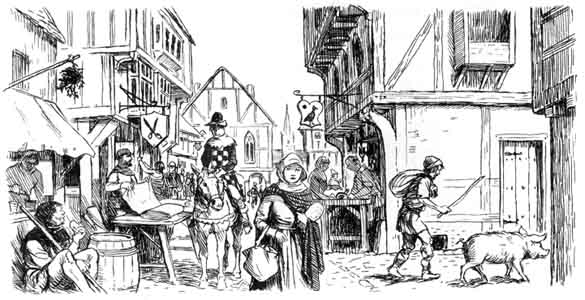
People used 'chamber pots' as urine collectors, that were to be emptied on the streets from time to time, sewers were open, and were commonly used as toilets and the slaughter houses left animal remains right where they were, after salvaging the bits that could be sold. So, if you were to take a walk through the streets of London, you would need to wear gumboots, and watch your step all the time, as it was not uncommon to find copious amounts of human and animal excrement strewn all over the place. How much more unsanitary could people ever get? I was taught in a history lesson that the Ancient Romans used public toilets which were a series of holes on which people sat, did their business and used public sponges on a stick that was left in a small stream of running water to clean their nether regions. Hence the spread of leprosy, and before the use of cutlery became common, people used their hands for eating, and were in the habit of cleaning their dirty fingers on their unwashed clothes after eating. Apparently this general disregard for hygiene lingered till the mid-19th century.
I was shocked when, in the movie 'Perfume', they show that the man with no smell was born to a fisher woman in the foulest smelling region of Paris, and she gives birth right where she worked, in middle of the market, and lets her baby just drop onto the filthy floor, assuming it to be dead like her four previous babies that she had lost, and threw the newborn in her growing pile of fish entrails and whatnot under the table, until people found the baby under her table, alive and well, and assuming that she tried to kill her own child, had her executed and sent him to an orphanage where, tragically, he grows up being disliked by all the other orphans, to the extent that they tried to even kill him.
What's worse, when people got sick, they got scared, and often, the fear, lack of sanitation, personal hygiene, good, clean, healthy food and correct medication killed them. That's why, you would only read/watch a person on TV actually saying that they were dying - because people nowadays know their risks, and don't usually say that they are dying the way people used to say then, when death was something that came sooner than later. People dropped dead like flies - frequent wars and the plague were the most talked about, but people also died of starvation, poor health and a million other preventable/curable diseases and violence simply because they didn't know better.
Now, just as I said that, I can almost hear a person in the future saying the same about diseases like cancer and AIDS - we still don't know how one person gets it and another doesn't and we don't know of a miracle pill that would make it magically just vanish, but I believe that one day people will.
In times when there were wars raging, times got even harder, and the lack of sanitation got even more pronounced. During all three outbreaks of the plague, which by the way was transmitted by rats, people with carts knocked on every door and collected the dead in a cart and buried hundreds of bodies together. They considered illness a curse rather than an actual disease, and so people just kept dying, and nothing could be done to stop it until the disease had run its course, and finally stopped spreading.
Lepers were locked away, and just left to die with the thought that they brought that fate upon themselves.These were also times when people resorted to cannibalism when they were starving, as explained by the Jamestown, and in other times of starvation, such as famine and shipwreck, which, by the way, also happened more often back then than it happens today. There are stories of people eating their own children, aborted fetuses and drinking blood and urine and getting diseases that are only transmitted by fecal contamination of the food and water supply because of improper sanitation and the use of public bath houses where people shared baths.
Anyway, people were less safe than they are now. First, imagine getting put away in an asylum or in a jail just because your boss, Mr. Moneybags thought you were a smartass. If someone of authority got angry with you, they could do anything to you, and just get away with it. There are countless stories where this has been spoken of. Edmund Dantes, Benjamin Barker, Jean Valjean, Pip's benefactor and so many others. There are stories of women being raped in public, and in a book that I read, a pregnant woman was actually sold in the market like cattle. Women could be blamed of practicing witchcraft and burnt at the stake at the drop of a hat, and if the Jamestown cannibalism was any testimony, it is to the fact that people even got eaten.
I remember wondering about three things as I watched Sweeney Todd. First, Sweeney Todd killed that many people and died before people realized that he was a murderer. Second, how much desperation had to be there for Mrs. Lovett to look at Pirelli and think - 'what a waste of meat', instead of run the other way, seeing as Todd had killed a person in a fit of rage. Third, people actually thought they could get away with selling 'piss and ink' in a bottle? That's really a testament to how ignorant people were back then.
My heart broke for Lucy as I saw the beautiful woman turn into an unrecognizable, dirty, insane shadow of a woman roaming the streets, begging in her threadbare rags. Also, if Mrs. Mooney could get away with making pies out of cat meat, and Mrs. Lovett with human flesh, those had to be awfully hard times. I literally shuddered, when Toby found a finger in his pie. Also, imagine how terrible the meat pie smoke should have smelt if people who live in squalor complained of an ungodly smell - we're talking about people whose noses have grown accustomed to faeces, urine, vomit, animal guts and the collective rancidity of people who have not bathed in months or years.
The description of the smell of the city in the beginning of Süskind's Perfume:
"In the period of which we speak, there reigned in the cities a stench barely conceivable to us modern men and women. The streets stank of manure, the courtyards of urine, the stairwells stank of moldering wood and rat droppings, the kitchens of spoiled cabbage and mutton fat; the unaired parlors stank of stale dust, the bedrooms of greasy sheets, damp featherbeds, and the pungently sweet aroma of chamber pots. The stench of sulfur rose from the chimneys, the stench of caustic lyes from the tanneries, and from the slaughterhouses came the stench of congealed blood. People stank of sweat and unwashed clothes; from their mouths came the stench of rotting teeth, from their bellies that of onions, and from their bodies, if they were no longer very young, came the stench of rancid cheese and sour milk and tumorous disease. The rivers stank, the marketplaces stank, the churches stank, it stank beneath the bridges and in the palaces.The peasant stank as did the priest, the apprentice as did his master’s wife, the whole of the aristocracy stank, even the king himself stank, stank like a rank lion, and the queen like an old goat, summer and winter."
Those times were far too hard to survive in, even by the affluent people. Anna Karenina was a free spirit who made all the wrong choices as a rebellion to the uptight society she lived in. Women were trapped, and taught to only be in a certain way. Women were not allowed to study or work as freely as they are today, and when they had no money or food, they had to resort to prostitution, like Fantine. Orphans like Cosette lived at the mercy of terrible parents or were sent to the workhouses, where conditions were deplorable, of course. There really was no free will to speak of. Men were dominated by their fathers/uncles/some authority figure. The low class citizens worked to the bone and were cheated and controlled by their masters - beaten, tortured, manipulated and underpaid. Jails, hospitals and asylums were much, much worse, so when a person got sick, he/she was as good as dead.
Although the stories of knights in shining armour are heavily romanticized, Sweeney Todd gave me the wake up call I feel I needed. In spite of being a major history buff and watching movies and compulsively reading stories about those times and wishing I could actually marry a gentleman of those times, I concede that I was being dreamy, and impractical. Those may be great stories to read, but I would never envy the life they had. Never - not even for a second.
Interestingly, it was said though, that the Ancient Greeks adopted the habit of regular bathing from the Hindus, who knew about the benefits of bathing even as early as 3000 years ago.
I took some information from these links:
http://www.guardian.co.uk/commentisfree/2013/may/05/cannibalism-history-europe-famine-shipwreck
[http://www.todayifoundout.com/index.php/2011/05/why-bathing-was-uncommon-in-medieval-europe/]
However, 2 hours of Sweeney Todd, and 2 more of Perfume - the story of a murderer completely showed me the error of my thoughts. It also left me with a lingering sadness and an ache for people who lived in those times. Life was horrible to them. The romance of a knight in shining armour saving a damsel in distress was only too literal back then, since every single thing was a struggle for those who were not royal, or even slightly well off. There was despair and loss all around. There was more fear, ignorance and cruelty than there is now, and there is the part where there was little or no hygiene. When people got sick, doctors prescribed vile concoctions that people drank without question because they trusted the doctor to know best. The worst I could ever imagine is being operated on without an anesthetic, only to end up in a worse state or even, dying. Today, even in the most pristine surgical wards, patients end up with post-op complications and nasty infections and have drug allergies that are carefully considered. People still die of unknown causes after an operation - just imagine what it would have been like without all the medical knowledge we have now. Imagine surgery without an anesthetic or a sterile Operating Room. There are also those morbid stories of demented physicians and psychiatrists who experimented on their patients.
The best horror stories ever told are of haunted asylums purely because the horrors and despair were palpable. The horrible truth, though, was that many, many people with no actual mental affliction have been sent to these godforsaken places. If an employee accidentally crossed a higher-up who wanted to throw you in a place where no one would believe a word you said, in he would go, kicking and screaming - and if he didn't calm down, they'd inject him with tranquilizers to completely knock him out. Of course no one listened to his cries for help because in their minds, he was just another raving lunatic. The shock treatments, the crazy drugs and the way people treated him, like he was an animal - he would go insane if he already wasn't. Other people who got thrown in were people who weren't like everyone else - homosexuals, transgenders and other innocent victims of the cold, hard, unforgiving system. These places were dark, dank and filthy, and bred more despair than there already was. Of course those places were haunted. Even the insane among the living are infinitely unpredictable, violent and a danger, both to themselves and to others. Imagine what an angry, insane ghost would be like, if such things were to exist!
Also, apparently, the church prohibited Christians from bathing naked and in bath houses, saying that it did not approve of the "excessive indulgence" in the habit of bathing, and proclaiming that public bathing led to immorality, promiscuous sex and diseases. They also thought that bathing warmed the body and widened the pores, allowing microorganisms in the air and the water to enter the body. Since bathing was connected to the spread of diseases, most low class citizens, particularly men, just conveniently forwent the process of bathing. During this time, people only rinsed their mouths and washed their hands and parts of their face, believing that washing one's face completely would result in catarrh or weakened eyesight! Women made a ritual of brushing their hair relentlessly every night to comb out the grease, dust and the remnants of the day, but no actual washing was spoken of. If you've read the classics, I'm sure you would have come across the line 'and her mother brushed her hair out until it shone' at least once.
Members of the upper class only took a few baths per year, purely risking the spread of disease to get rid of body odour. Apparently, King Louis XIV stunk like a wild animal because he was told that he was to bathe as infrequently as possible to maintain good health. He also managed to make a statement of the fact that he found bathing 'disturbing'. Him, and Queen Isabel I of Spain claimed to have taken only two baths in their entire lifetime. Queen Isabel actually said that she only bathed once when she was born, and once when she got married. Disgusting, right?
Some very self-righteous members of the clergy went so far as calling the Russians 'perverts' because they bathed at least once a month. So, when I hear someone of that era say 'foul breath', I tend to wonder - er, yeah, because everyone else's mouth smells so minty fresh, right? I mean, toothpaste wasn't a thing, and people only rinsed their mouths - what does that leave us with? So how bad did someone's mouth need to smell for them to consider it 'foul breath'?
If it had to be at home, bathing involved hauling and heating water, and the need for privacy made it more difficult. Not many people lived very close to wells, so, bathing was far less common than it is today. Peasants couldn't afford to waste the little firewood they collected on boiling water, and if they needed to fill a bath, they would need to haul out buckets of water and carry it back to a tent or their homes where there would be a rickety tin/wooden bath tub. Since this was such an ordeal, everyone in the house shared the bathwater, which was obviously so terribly unhygienic in itself. Naturally, even a hot bath was a luxury back then. So people just went for months without taking a bath. If they had to clean up, they took sponge baths using rags, and wore perfume and carried herbs and flowers to mask the smell. No wonder they had so many diseases that people don't even hear of today.
People used 'chamber pots' as urine collectors, that were to be emptied on the streets from time to time, sewers were open, and were commonly used as toilets and the slaughter houses left animal remains right where they were, after salvaging the bits that could be sold. So, if you were to take a walk through the streets of London, you would need to wear gumboots, and watch your step all the time, as it was not uncommon to find copious amounts of human and animal excrement strewn all over the place. How much more unsanitary could people ever get? I was taught in a history lesson that the Ancient Romans used public toilets which were a series of holes on which people sat, did their business and used public sponges on a stick that was left in a small stream of running water to clean their nether regions. Hence the spread of leprosy, and before the use of cutlery became common, people used their hands for eating, and were in the habit of cleaning their dirty fingers on their unwashed clothes after eating. Apparently this general disregard for hygiene lingered till the mid-19th century.
I was shocked when, in the movie 'Perfume', they show that the man with no smell was born to a fisher woman in the foulest smelling region of Paris, and she gives birth right where she worked, in middle of the market, and lets her baby just drop onto the filthy floor, assuming it to be dead like her four previous babies that she had lost, and threw the newborn in her growing pile of fish entrails and whatnot under the table, until people found the baby under her table, alive and well, and assuming that she tried to kill her own child, had her executed and sent him to an orphanage where, tragically, he grows up being disliked by all the other orphans, to the extent that they tried to even kill him.
What's worse, when people got sick, they got scared, and often, the fear, lack of sanitation, personal hygiene, good, clean, healthy food and correct medication killed them. That's why, you would only read/watch a person on TV actually saying that they were dying - because people nowadays know their risks, and don't usually say that they are dying the way people used to say then, when death was something that came sooner than later. People dropped dead like flies - frequent wars and the plague were the most talked about, but people also died of starvation, poor health and a million other preventable/curable diseases and violence simply because they didn't know better.
Now, just as I said that, I can almost hear a person in the future saying the same about diseases like cancer and AIDS - we still don't know how one person gets it and another doesn't and we don't know of a miracle pill that would make it magically just vanish, but I believe that one day people will.
In times when there were wars raging, times got even harder, and the lack of sanitation got even more pronounced. During all three outbreaks of the plague, which by the way was transmitted by rats, people with carts knocked on every door and collected the dead in a cart and buried hundreds of bodies together. They considered illness a curse rather than an actual disease, and so people just kept dying, and nothing could be done to stop it until the disease had run its course, and finally stopped spreading.
Lepers were locked away, and just left to die with the thought that they brought that fate upon themselves.These were also times when people resorted to cannibalism when they were starving, as explained by the Jamestown, and in other times of starvation, such as famine and shipwreck, which, by the way, also happened more often back then than it happens today. There are stories of people eating their own children, aborted fetuses and drinking blood and urine and getting diseases that are only transmitted by fecal contamination of the food and water supply because of improper sanitation and the use of public bath houses where people shared baths.
Anyway, people were less safe than they are now. First, imagine getting put away in an asylum or in a jail just because your boss, Mr. Moneybags thought you were a smartass. If someone of authority got angry with you, they could do anything to you, and just get away with it. There are countless stories where this has been spoken of. Edmund Dantes, Benjamin Barker, Jean Valjean, Pip's benefactor and so many others. There are stories of women being raped in public, and in a book that I read, a pregnant woman was actually sold in the market like cattle. Women could be blamed of practicing witchcraft and burnt at the stake at the drop of a hat, and if the Jamestown cannibalism was any testimony, it is to the fact that people even got eaten.
I remember wondering about three things as I watched Sweeney Todd. First, Sweeney Todd killed that many people and died before people realized that he was a murderer. Second, how much desperation had to be there for Mrs. Lovett to look at Pirelli and think - 'what a waste of meat', instead of run the other way, seeing as Todd had killed a person in a fit of rage. Third, people actually thought they could get away with selling 'piss and ink' in a bottle? That's really a testament to how ignorant people were back then.
My heart broke for Lucy as I saw the beautiful woman turn into an unrecognizable, dirty, insane shadow of a woman roaming the streets, begging in her threadbare rags. Also, if Mrs. Mooney could get away with making pies out of cat meat, and Mrs. Lovett with human flesh, those had to be awfully hard times. I literally shuddered, when Toby found a finger in his pie. Also, imagine how terrible the meat pie smoke should have smelt if people who live in squalor complained of an ungodly smell - we're talking about people whose noses have grown accustomed to faeces, urine, vomit, animal guts and the collective rancidity of people who have not bathed in months or years.
The description of the smell of the city in the beginning of Süskind's Perfume:
"In the period of which we speak, there reigned in the cities a stench barely conceivable to us modern men and women. The streets stank of manure, the courtyards of urine, the stairwells stank of moldering wood and rat droppings, the kitchens of spoiled cabbage and mutton fat; the unaired parlors stank of stale dust, the bedrooms of greasy sheets, damp featherbeds, and the pungently sweet aroma of chamber pots. The stench of sulfur rose from the chimneys, the stench of caustic lyes from the tanneries, and from the slaughterhouses came the stench of congealed blood. People stank of sweat and unwashed clothes; from their mouths came the stench of rotting teeth, from their bellies that of onions, and from their bodies, if they were no longer very young, came the stench of rancid cheese and sour milk and tumorous disease. The rivers stank, the marketplaces stank, the churches stank, it stank beneath the bridges and in the palaces.The peasant stank as did the priest, the apprentice as did his master’s wife, the whole of the aristocracy stank, even the king himself stank, stank like a rank lion, and the queen like an old goat, summer and winter."
Those times were far too hard to survive in, even by the affluent people. Anna Karenina was a free spirit who made all the wrong choices as a rebellion to the uptight society she lived in. Women were trapped, and taught to only be in a certain way. Women were not allowed to study or work as freely as they are today, and when they had no money or food, they had to resort to prostitution, like Fantine. Orphans like Cosette lived at the mercy of terrible parents or were sent to the workhouses, where conditions were deplorable, of course. There really was no free will to speak of. Men were dominated by their fathers/uncles/some authority figure. The low class citizens worked to the bone and were cheated and controlled by their masters - beaten, tortured, manipulated and underpaid. Jails, hospitals and asylums were much, much worse, so when a person got sick, he/she was as good as dead.
Although the stories of knights in shining armour are heavily romanticized, Sweeney Todd gave me the wake up call I feel I needed. In spite of being a major history buff and watching movies and compulsively reading stories about those times and wishing I could actually marry a gentleman of those times, I concede that I was being dreamy, and impractical. Those may be great stories to read, but I would never envy the life they had. Never - not even for a second.
Interestingly, it was said though, that the Ancient Greeks adopted the habit of regular bathing from the Hindus, who knew about the benefits of bathing even as early as 3000 years ago.
I took some information from these links:
http://www.guardian.co.uk/commentisfree/2013/may/05/cannibalism-history-europe-famine-shipwreck
[http://www.todayifoundout.com/index.php/2011/05/why-bathing-was-uncommon-in-medieval-europe/]

